5 Ways AI Procurement Agents Will Change B2B Distribution
AI procurement agents are reshaping B2B distribution, from instant quoting to dynamic pricing. Here are 5 concrete ways distributors are winning with AI today.

5 Ways AI Procurement Agents Will Change B2B Distribution
The B2B distribution industry processes over $1 trillion in annual transactions, yet most procurement workflows haven't changed meaningfully since the internet arrived. A procurement manager spends 40% of her day assembling quotes. A purchasing agent loses 15–20% of competitive deals to slower response times. A supply chain planner resets safety stock manually based on gut instinct rather than consumption data.
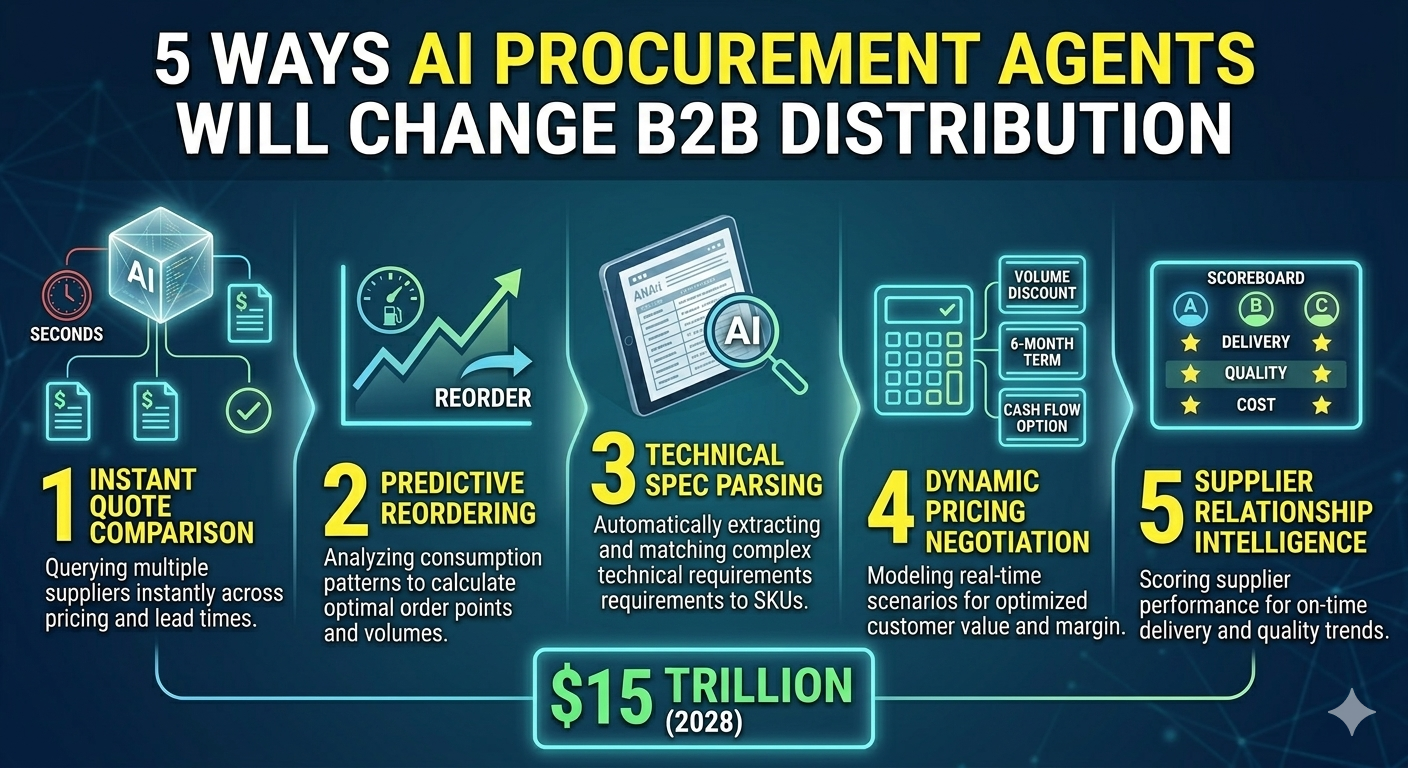
AI procurement agents don't just optimize these workflows. They fundamentally restructure how distributors win business and manage inventory.
Here are five concrete ways this transformation is already beginning.
1. Instant Quote Comparison Across Suppliers
The Problem: A buyer needs 200 units of a specific industrial pump. Procurement emails three suppliers. Supplier A responds in 8 hours. Supplier B in 24 hours. Supplier C never responds. The buyer compares pricing in a spreadsheet, factoring in lead times and payment terms. Decision takes three days.
Research shows 15–20% of B2B buyers move forward with the first responder. Speed determines winners.
How AI Agents Change This: An AI procurement agent integrated with a distributor's system can ingest the specification instantly via email, voice, or structured input, query real-time inventory, cross-reference pricing matrices with volume discounts and geographic adjustments, check supplier scorecards, compare against preferred supplier lists and compliance requirements, and return a complete quote comparison across 3–5 suppliers — all in seconds.
Concrete Example: A manufacturing plant's procurement system sends an AI agent a request: "1,000 units of SKU-4429X, delivery by Q2, pre-tax budget $45K." The agent checks inventory (in stock, 5-day lead time), applies volume pricing (drops from $48/unit to $42/unit), routes to the correct salesperson, flags alternate suppliers with better lead times, and generates a formatted RFQ for the buyer — within 90 seconds. The distributor wins before competitors even respond to the initial inquiry.
🏁 Leaders are already pulling ahead. See how the CommerceFlow platform is built to help you catch up — fast. Explore the CommerceFlow platform →
2. Automated Reordering Based on Consumption Patterns
The Problem: A hospital needs to maintain stock of critical medical supplies. A facilities manager guesses at order volumes based on historical data — usually inaccurate. Stock runs out unpredictably. Emergency orders incur rush fees. Slow-moving inventory ties up cash. Safety stock is set conservatively to avoid stockouts, but that's expensive.
How AI Agents Change This: An AI procurement agent connected to the buyer's consumption data can analyze purchase history, seasonal patterns, and growth trends, calculate optimal reorder points and quantities, predict demand spikes, automatically generate standing orders at the optimal moment, adjust pricing based on timing, and alert the distributor to contract renewal or volume upgrade opportunities.
Concrete Example: A hotel chain uses an AI agent that tracks maintenance supply usage across 15 properties. The agent notices HVAC filter consumption spikes 6 weeks before summer. It automatically pre-orders filters 8 weeks out to capture volume discount pricing, coordinates delivery across multiple properties, routes the order to the distributor with the best lead time at that volume, and updates the budget forecast for procurement finance. The hotel maintains optimal inventory. The distributor secures predictable revenue.
3. Spec-Sheet Parsing for Technical Products
The Problem: A manufacturing engineer needs a motor with specific torque, RPM, and efficiency ratings. The requirement is buried in a 40-page PDF datasheet. The distributor's catalog has 3,000 similar products, but SKU descriptions are inconsistent. Matching the spec to the right SKU takes 2–3 hours of manual cross-reference work. Procurement gets frustrated. They call a competitor who "just knows" the product. The order goes elsewhere.
How AI Agents Change This: An AI procurement agent trained on technical specifications can extract attributes from unstructured datasheets — PDFs, images, Word docs — normalize specs against the distributor's standard taxonomy, match customer requirements to SKUs with high confidence, flag equivalent products or suggest optimizations, handle technical exceptions like modified specs and custom configurations, and document matching logic for compliance and traceability.
Concrete Example: A construction company uploads a 30-page equipment spec sheet. An AI agent extracts key parameters — horsepower, voltage, cooling type, enclosure rating — cross-matches against distributor inventory, identifies three options in stock (primary, backup, cost-optimized), flags that the company's last order used an older variant with preferred pricing still available, and generates a comparison table with lead times and technical notes. The procurement team gets clarity in 3 minutes instead of 3 hours.
Distributor wins the deal. No phone tag. No manual lookup.
4. Dynamic Pricing Negotiation
The Problem: A salesperson quotes pricing based on standard list, standard discounts, and historical customer behavior. But the customer's opportunity to negotiate disappears in static quotes. They can't quickly explore "what if we ordered more?" or "can we get better terms on a 6-month agreement?" Buyers feel static quotes are inflexible. Salespeople feel pressured to give away margin to keep the deal moving.
How AI Agents Change This: An AI procurement agent can model pricing scenarios in real-time across different volumes, payment terms, and contract lengths, understand margin thresholds and internal pricing constraints, present the buyer with optimized options that preserve margin while increasing customer value, negotiate within guardrails — maximum discount, minimum order, contract minimums, factor in customer lifetime value and competitive risk, and suggest value-adds instead of price cuts.
Concrete Example: A buyer asks for a quote on 500 units. Standard pricing is $50/unit. An AI agent proposes:
- Option A: 500 units at $50/unit = $25K (fastest decision)
- Option B: 1,000 units at $45/unit = $45K (volume discount, 6-month inventory)
- Option C: 500 units at $48/unit + 60-day terms = $24K (cash flow relief without inventory burden)
The buyer gets clarity on trade-offs. The distributor captures higher revenue and preserves margin.
5. Supplier Performance Scoring and Relationship Intelligence
The Problem: A procurement manager works with dozens of suppliers. Some are reliable; others miss lead times or have quality issues. She tracks this informally in her head or in scattered notes. When a new buyer joins the team, that institutional knowledge is lost. Supplier relationships get reset. Quality issues get discovered too late. Lead time surprises derail production schedules.
How AI Agents Change This: An AI procurement agent can track supplier performance across all key metrics, on-time delivery, quality, responsiveness, pricing consistency — flag outliers and trend changes, score suppliers for specific criteria, route orders intelligently, alert the procurement team to relationship risks, and surface negotiation leverage when competitors outperform on delivery or market prices shift.
Concrete Example: Supplier A has 98% on-time delivery but 12% higher pricing. Supplier B has 89% on-time delivery but charges 8% less. An AI agent scores Supplier A as "high reliability" for mission-critical items and Supplier B as "high value" for planned replenishment. It automatically routes urgent orders to Supplier A, bulk planned orders to Supplier B, and alerts procurement when Supplier B's delivery slides below 85%, triggering re-scoring and a proactive conversation. The procurement team moves from reactive firefighting to proactive relationship management.
The Distribution Advantage
These five shifts — instant quoting, predictive reordering, spec parsing, dynamic pricing, and supplier intelligence, solve the core problems that plague B2B distribution:
- Speed - Procurement teams that move faster capture deals
- Inventory optimization - Better demand prediction reduces carrying costs and stockouts
- Technical accuracy - Correct SKU matching reduces returns and customer frustration
- Margin protection - Dynamic pricing captures more value while staying competitive
- Relationship depth - Intelligence about supplier performance strengthens partnership decisions
Distributors that deploy these capabilities first will own customer relationships for years to come. Buyers will default to "my AI agent talks to them, they just understand what I need."
The Starting Point
These capabilities sound complex, but they don't require building from scratch. Purpose-built AI procurement agents designed for B2B distribution can integrate with existing ERP systems, catalogs, and pricing engines.
The question isn't whether AI procurement agents will transform distribution. The question is when your distributor will deploy them.
📈 18–38x ROI in year one. See how distributors in your industry are hitting those numbers. Explore CommerceFlow by industry →
CommerceFlow's SalesPulse agent is built specifically for B2B distribution. It learns your pricing, catalogs, and approval workflows, then handles quotes, comparisons, and negotiations autonomously. Schedule a demo →