The Agentic Commerce Gap: Why B2B Sellers Are Running Out of Time
This post breaks down the agentic commerce gap: why most B2B sellers are structurally invisible to the AI their buyers are deploying.

The Agentic Commerce Gap: Why B2B Sellers Are Running Out of Time
There's a quiet revolution underway in B2B procurement and most sellers are watching it happen from the wrong side of the window.
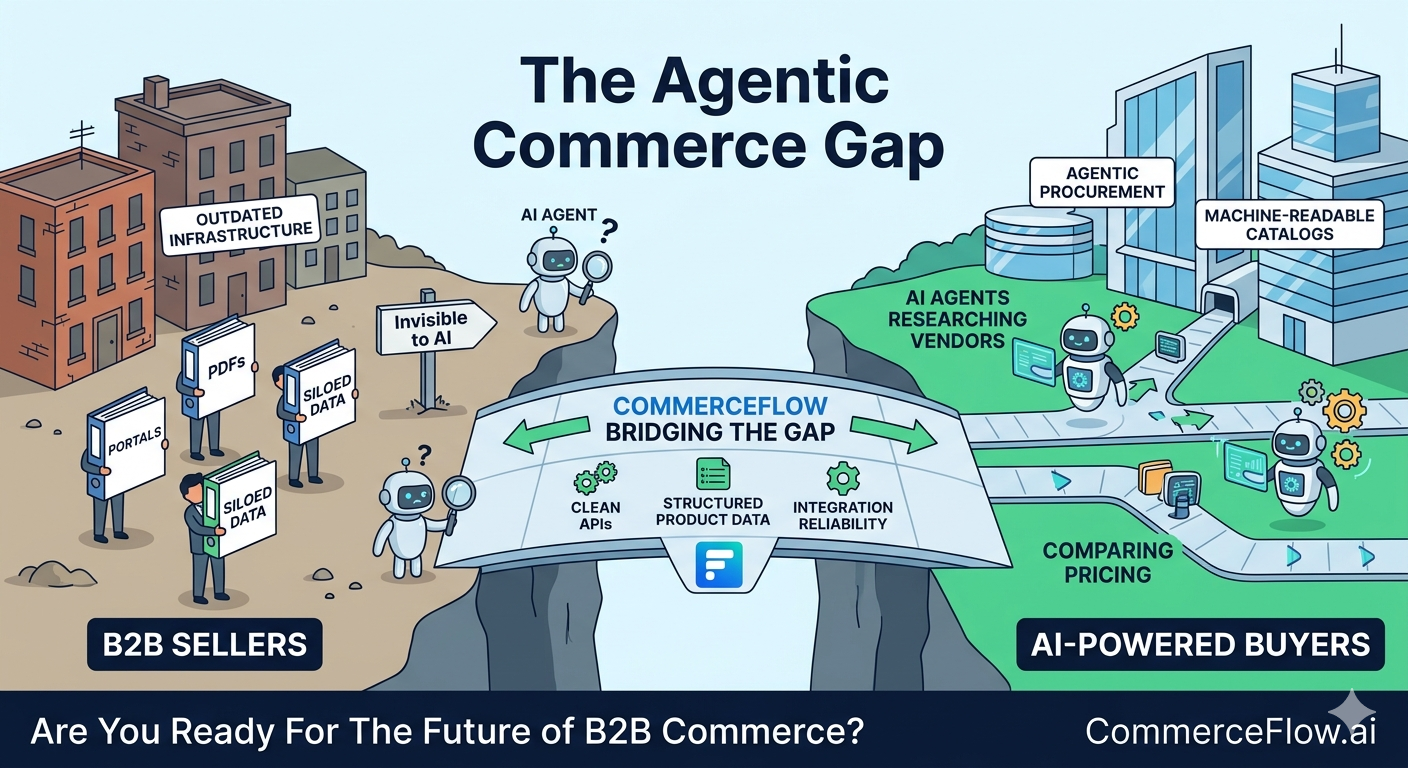
AI agents are no longer a speculative concept. They're actively researching vendors, comparing pricing, evaluating catalogs, and in many cases, initiating purchase requests — all without a human buyer touching a keyboard. The companies building these agents aren't waiting for the market to catch up. And that's exactly the problem.
The agentic commerce gap is the widening chasm between how AI-powered buyers now operate and how the majority of B2B sellers are still set up to sell. If you're relying on the same sales motions, portals, and data structures you had two years ago, you're not just behind — you're increasingly invisible.
What "Agentic" Actually Means for B2B Commerce
Agentic AI refers to systems that don't just respond to prompts — they pursue goals. They plan, take action, evaluate outcomes, and iterate. Applied to procurement, this means an AI agent at a Fortune 500 company might be tasked with sourcing five qualified vendors for industrial components, comparing total cost of ownership, and flagging the top two for human approval.
That agent doesn't browse your website the way a human does. It doesn't respond to your outbound SDR sequence. It queries APIs, reads structured product data, checks compliance documentation, and cross-references pricing against market benchmarks — in minutes.
The question isn't whether your buyers will eventually deploy agents like these. Many already have. The question is: when an agent comes looking, will it find what it needs?
The Gap Is Already Opening
The numbers tell a striking story. According to Gartner, AI agents will intermediate more than $15 trillion in B2B spending by 2028 — with 90% of all B2B purchases eventually handled through automated exchanges. On the buyer side, 61% of B2B buyers already report using AI in purchasing decisions, with 38% already operating agentic systems.
The supply side hasn't kept pace. Deloitte Digital's research shows that only 24% of B2B suppliers are currently using agentic AI — a gap of more than 14 points versus their own buyers. And while 64% of B2B leaders recognize AI will have a "very significant" impact on digital sales, only 20% feel prepared for what's coming.
Meanwhile, the average B2B seller's digital infrastructure — PDFs, semi-updated portals, siloed ERP data, inconsistent product taxonomies — was designed for human patience, not machine precision.
This mismatch creates three compounding problems:
1. You become unsearchable. AI agents depend on clean, structured, queryable data. If your catalog isn't machine-readable, your pricing isn't accessible via API, and your product attributes aren't standardized, you simply won't show up in agentic workflows — even if you're the best option in the market.
2. You lose deals before they start. Traditional B2B sales funnels assume a human enters at some point — filling out a form, taking a call, responding to an email. Agentic procurement can shortlist, score, and eliminate vendors entirely before a human ever gets involved. If you're not optimized for that pre-human layer, you're not even in the game.
3. Your competitors who adapt will compound their advantage. This is the time dimension most sellers underestimate. Deloitte found that digitally "mature" suppliers exceeded annual sales growth targets by 110% more than low-maturity competitors. The sellers who become agent-ready now will build data, relationship signals, and integration depth that create durable moats. By the time the laggards catch up, the gap won't be a quarter — it will be years.
This Isn't Just a Technology Problem
It's tempting to frame the agentic commerce gap as an IT challenge — something to be solved with a better API or a catalog refresh. But the deeper issue is strategic.
B2B selling has always been about relationships, trust, and positioning. Agentic commerce doesn't eliminate those things — it moves where they're established. Trust now gets built through data quality, documentation completeness, and integration reliability. Relationships are mediated by how seamlessly your systems communicate with your buyer's systems.
The sellers who will win aren't necessarily those with the most sophisticated AI of their own. They're the ones who make themselves easy to work with for the AI their buyers are already using.
That means rethinking your digital presence not as a storefront for human visitors, but as an infrastructure layer that agentic systems can navigate reliably. It means investing in structured product data, machine-readable pricing, clean APIs, and the kind of operational transparency that AI agents require to make confident recommendations. Forrester predicts that buyers' procurement teams will deploy agents capable of "scaling negotiation across hundreds of suppliers simultaneously" — turning static pricing pages into dynamic negotiation interfaces.
The Window Is Narrowing
The good news: most of your competitors haven't figured this out yet. Despite 90% of procurement leaders signaling intent to adopt AI agents, only 4% have achieved large-scale deployment. The window to move first — and move well — is still open. But it won't be for long.
Procurement teams that have deployed agents are learning quickly what works. The vendors who show up cleanly in agentic workflows are getting added to approved lists, preferred vendor registries, and automated reorder flows. Those who don't are getting filtered out — quietly, systematically, and without a single declined sales call to signal the loss.
The buyers of 2027 will look very different from the buyers of 2023. Some of your best customers are already partway there. The question for B2B sellers right now is simple: Are you building for the buyer that exists today, or the one that's already emerging?
The agentic commerce gap is real, and it's growing every quarter. The sellers who close it early won't just survive the transition — they'll define what modern B2B commerce looks like on the other side.
Ready to Bridge the Gap?
CommerceFlow is built for exactly this moment — helping B2B sellers structure their commerce operations for a world where AI-powered buyers are the norm, not the exception.
Explore how CommerceFlow helps you become agent-ready →
Tags: B2B Commerce · Agentic AI · Procurement · Digital Transformation · Sales Strategy