B2C Has AI Shopping Agents. B2B Has... Spreadsheets.
Last month, your teenage daughter bought a dress using ChatGPT's Instant Checkout. She described the style, neckline, and color preferences, and the AI ...

B2C Has AI Shopping Agents. B2B Has... Spreadsheets.
Last month, your teenage daughter bought a dress using ChatGPT's Instant Checkout. She described the style, neckline, and color preferences, and the AI agent handled the rest: browsing, comparing reviews, checking inventory across retailers, and completing the purchase. No clicking. No copy-pasting. No tabs open.
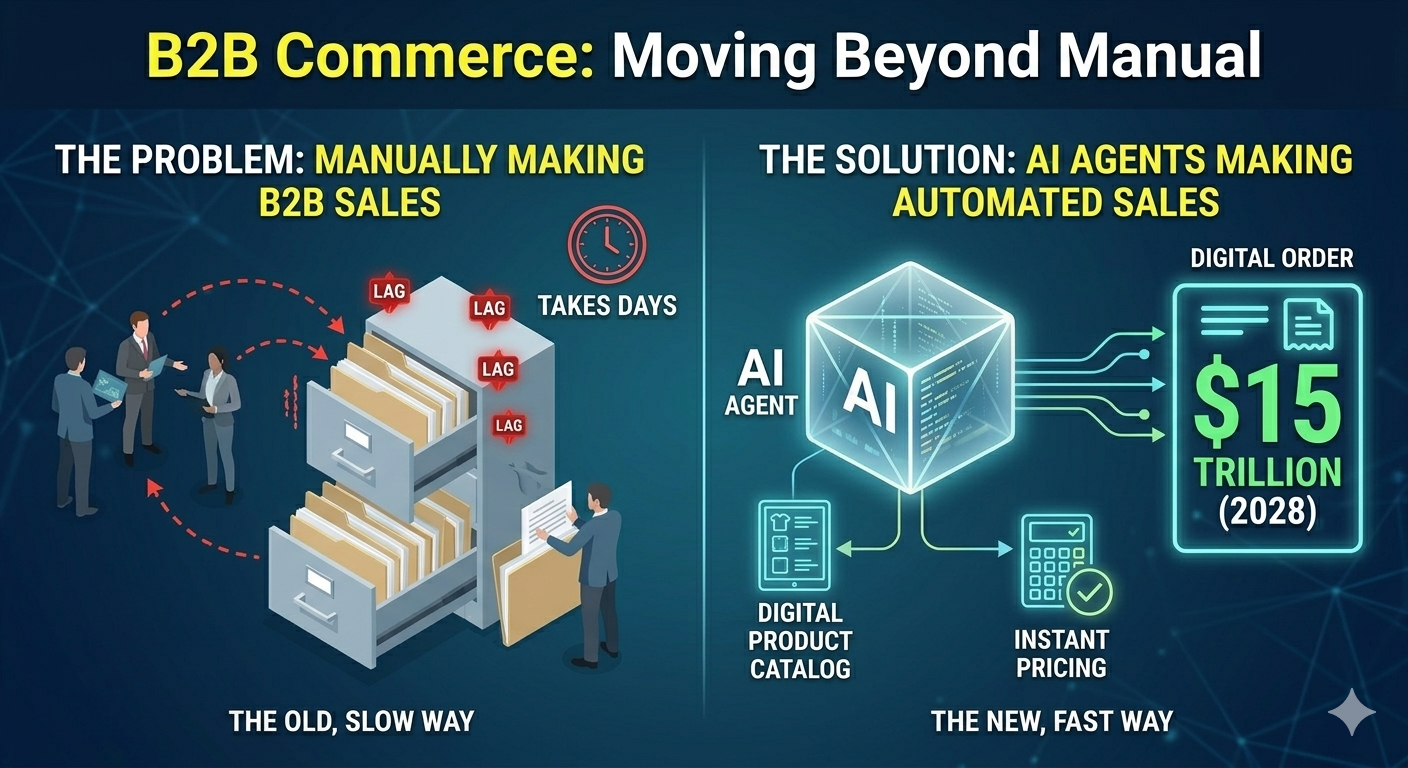
Meanwhile, across town, a $2M enterprise is still doing this: Sales rep opens spreadsheet. Manually gathers specs from three vendor email attachments. Copies pricing into a second spreadsheet. Adds margin in a third spreadsheet. Waits two days for approval. Sends a PDF quote to the buyer. Buyer uploads the PDF into their spreadsheet to compare against competitors' PDFs.
B2C has leapfrogged into agentic commerce. B2B is still working like it's 2005.
The Contrast Is Stark and Growing
B2C's AI Agent Moment: Google AI Mode now handles 15% of shopping queries without a click. ChatGPT's Instant Checkout integrates directly into hundreds of retailers. Amazon's Alexa completes reorders through voice. These aren't futuristic concepts, they're live today. Consumers expect an AI agent to understand their needs, navigate complexity, and execute in seconds.
B2B's Reality: A procurement director at a mid-market distributor still spends 40% of team bandwidth assembling quotes. According to Forrester, 20% of B2B sellers will face AI-driven negotiations in 2026, yet most don't have the infrastructure to be those AI agents. Instead, they're fighting the same bottleneck: manual data entry, version control nightmares, and approval delays.
The gap isn't narrowing. It's widening at velocity.
"But B2B Is Complex" - Exactly
Here's where people get it wrong. They say B2B is too complex for agents. Contracts vary. Pricing is custom. Customers demand approval chains. Technical specs are dense. SKUs number in millions.
That's not an argument against AI agents. It's an argument for them.
B2C agents work on simple problems: "Find me a blue shirt, size medium, $50–75." Powerful, but confined. The real complexity lives in B2B. B2B agents need to:
- Interpret custom pricing matrices with volume discounts, contract minimums, and seasonal adjustments
- Navigate approval workflows where the $10K threshold routes to one person, $50K+ to another
- Parse technical datasheets and match SKUs across fragmented catalogs
- Negotiate terms while respecting relationship history and customer lifetime value
- Handle exceptions, stockouts, lead times, special requests, that require judgment calls
This isn't a reason to stay manual. It's the reason AI agents matter more in B2B than in B2C.
🧑💼 Your best salespeople are doing admin work. SalesPulse gives them their time back. See how SalesPulse automates the entire quote-to-order workflow →
Why the Gap Exists
The bottleneck isn't technology. It's tooling.
B2C has been commoditizing agent development for three years. OpenAI, Google, and Amazon have invested billions in agent frameworks that work across millions of retailers with similar catalog structures, transparent pricing, and standard checkout flows. They standardized the problem, so they could scale the solution.
B2B hasn't standardized anything. Your ERP looks different from your competitor's. Your custom pricing model is exactly that, custom. Your product taxonomy probably doesn't match your buyer's. So the market hasn't developed the agents yet.
But that's changing. And the distributors and manufacturers who move first will capture the advantage.
What Agentic Commerce Looks Like in B2B
Imagine this instead. A procurement manager at a manufacturing plant needs 500 units of a specific fastener. She describes it to an AI agent: "M6 stainless steel bolts, Grade 8.8, 25mm length, hex head, DIN 933 spec." The agent instantly:
- Searches your catalog and cross-references five competitors
- Pulls pricing at that volume, with contract discounts factored in
- Checks current inventory and lead times
- Flags that Supplier A has a 2-week lead time; Supplier B has stock
- Runs the spec through her company's approved vendor list
- Routes the decision to the right approver based on her authority level
- Handles negotiation on payment terms based on customer history
- Generates the PO without her writing a single line
This takes seconds. The salesperson never touches it. The spreadsheet never opens.
⚙️ This isn't science fiction. It's live. And your competitors are watching. Book a 15-minute demo and see a real B2B agent quote workflow in action →
The Widening Opportunity
Gartner projects B2B commerce will reach $15 trillion annually and most of it will still be transacted through processes invented in the 1990s. McKinsey found that AI-driven procurement can unlock 25-40% efficiency gains, yet 86% of companies haven't meaningfully deployed procurement AI.
That gap represents billions in unrealized value. More importantly, it represents competitive disadvantage for the laggards.
The distributor who deploys an AI agent for quote generation will respond 3x faster. The one who automates reorder logic will retain customers before they find alternatives. The one who structures their catalog for agent readability will be discoverable in ways competitors aren't.
Meanwhile, everyone else will be explaining why their quote took five days.
💸 How much is slow quoting actually costing you? The number might surprise you. Use our free B2B Revenue Leak Calculator to find out →
B2B Won't Leapfrog — Yet
Here's the realistic timeline. B2C had a five-year head start. The infrastructure is built. The agents are live. Consumers are training on them. Integration is seamless.
B2B won't reach B2C's maturity for 18–24 months. But for the next 12 months, the competitive window is wide open. First-movers will establish:
- Customer expectations that their agents are responsive and intelligent
- Seller infrastructure that rivals can't easily replicate
- Data advantages, better catalog structure, cleaner pricing, richer customer history
- Experience data that trains their agents faster
The Real Gap Isn't Technology
The real gap is decision speed.
B2C companies moved fast because consumer expectations demanded it. B2B can move just as fast but only if leadership recognizes that the gap exists and that staying manual isn't safe anymore.
Your competition is watching how B2C agents work. They're thinking about how to bring that speed and intelligence to your industry. The question isn't whether B2B will have AI agents.
The question is: will you build them, or buy them?
CommerceFlow helps B2B distributors, manufacturers, and wholesalers deploy agentic commerce without rebuilding from scratch. Our SalesPulse agent learns your pricing, catalogs, and approval workflows - then handles quotes and negotiations in minutes, not days. Talk to CommerceFlow →