The $15 Trillion Shift: How AI Agents Are Reshaping B2B Buying
AI agents will command $15T in B2B purchases by 2028. Learn what's driving the shift and what B2B sellers must do right now to stay competitive.

The $15 Trillion Shift: How AI Agents Are Reshaping B2B Buying
In November 2025, Gartner made a prediction that should have made every B2B executive sit up straight: AI agents will command $15 trillion in B2B purchases by 2028. Not influence. Not assist. Command.
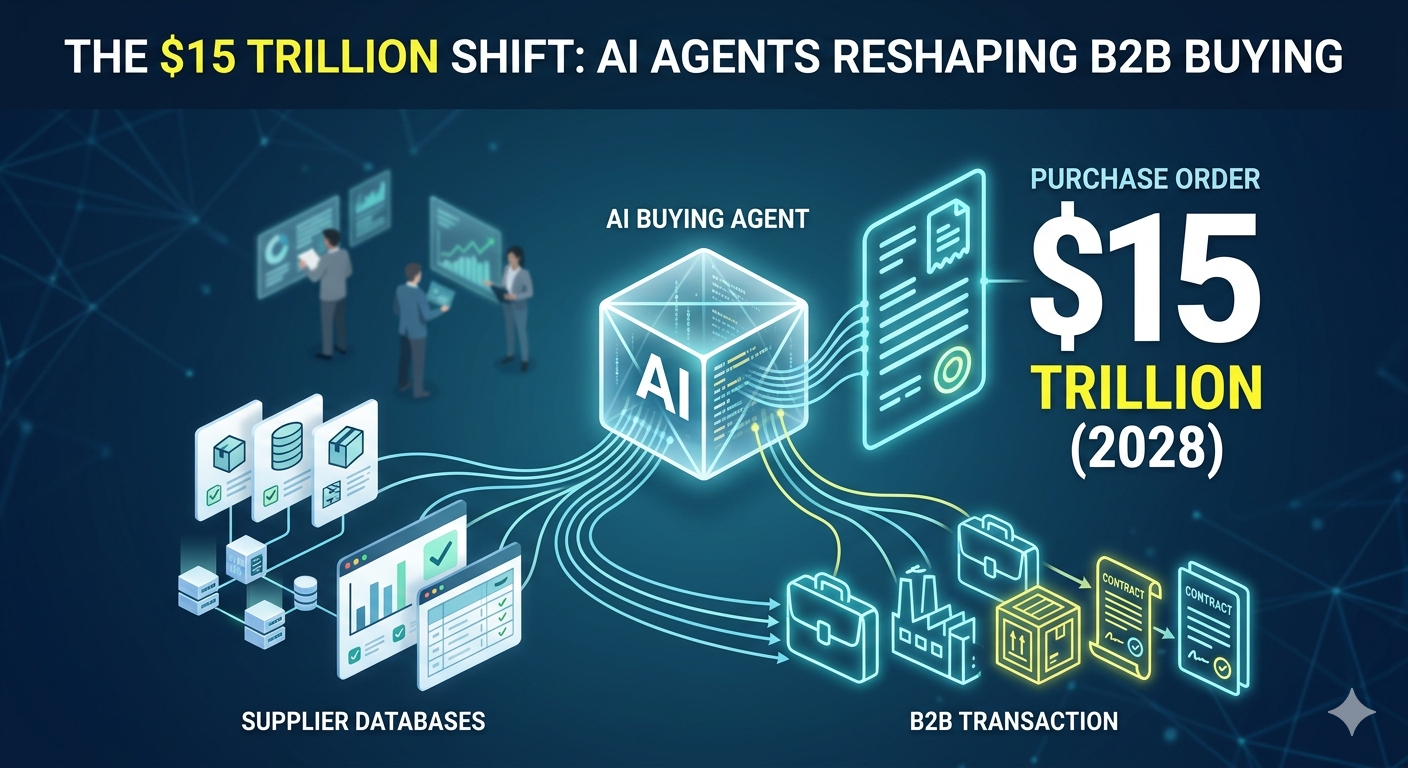
That number represents a fundamental rewiring of how businesses buy from each other. And it's happening faster than most B2B companies realize.
The Numbers Behind the Shift
Let's put the acceleration in context. McKinsey projects agentic commerce will drive $3–5 trillion globally by 2030. The global agentic AI market is jumping from roughly $5 billion in 2024 to nearly $200 billion by 2034, a 40%+ compound annual growth rate.
But the most telling statistic isn't about market size. It's about adoption speed. According to research by AI at Wharton, weekly use of generative AI within procurement functions increased 44 percentage points from 2023 to 2024. Ninety-four percent of procurement executives now use generative AI at least once a week.
And 90% of procurement leaders are implementing or planning to implement AI agents over the next 12 months.
This isn't a five-year horizon. This is a twelve-month horizon.
What's Actually Driving This
Three forces are converging to make B2B agentic commerce inevitable.
Force 1: The consumer side proved it works. ChatGPT's Instant Checkout, Google's AI Shopping Mode, and PayPal's agentic commerce services have demonstrated that AI agents can handle real commercial transactions at scale. The technology works. Now enterprise procurement teams are asking: why can't our purchasing be this efficient?
Force 2: B2B procurement is painfully manual. The average B2B purchase involves 6–10 decision makers, takes weeks to months, and requires extensive manual effort — from supplier research to quote comparison to approval routing. McKinsey estimates AI agents can make procurement 25–40% more efficient by automating non-value-added activities.
Force 3: Purpose-built procurement agents are emerging. This isn't about asking ChatGPT to find a supplier. Enterprise procurement platforms are building autonomous agents that can manage entire purchasing workflows, from demand recognition through supplier selection, quote negotiation, and order placement.
⏱️ How many deals did you lose this week to slow quotes? The number might shock you. See SalesPulse turn an RFQ into a quote in under 5 minutes →
What Procurement AI Agents Actually Do
Suplari estimates AI agents now automate 60–80% of routine procurement work. Here's what that looks like in practice.
Supplier discovery and evaluation. Instead of a procurement manager manually researching suppliers, an AI agent searches structured product databases, evaluates capabilities against requirements, checks compliance certifications, and generates a shortlist, in minutes rather than days.
Quote solicitation and comparison. The agent simultaneously requests quotes from multiple suppliers, normalizes the responses into a comparable format, flags pricing anomalies, and recommends the optimal choice based on price, quality, delivery time, and relationship history.
Contract negotiation. Forrester predicts 20% of B2B sellers will face agent-led quote negotiations this year. These aren't simple chatbots, they're agents armed with market data, historical pricing, and defined negotiation parameters.
Order management and reordering. Routine replenishment orders are handled entirely by agents, monitoring inventory levels, triggering reorders at optimal timing, and routing to the best supplier based on current pricing and availability.
The Seller's Dilemma
Here's the uncomfortable reality for B2B sellers: when AI procurement agents become the buyer, your traditional sales advantages disappear.
Relationship selling matters less when an algorithm is making the initial selection. Your sales rep's product knowledge is irrelevant if the AI agent can't parse your catalog. Your competitive pricing is invisible if your data isn't structured for machine consumption.
What matters in an agent-driven world is different. Your product data must be structured, complete, and machine-readable. Your quoting must be instant and programmatic. Your pricing must be transparent and API-accessible. Your catalog must be discoverable by procurement AI systems.
The companies that meet these requirements get considered. The ones that don't get filtered out before a human ever sees their name.
The Three-Year Timeline
Here's how this likely plays out.
2026 (now): Early adopters deploy procurement AI agents for routine purchasing categories. Progressive B2B sellers begin structuring their catalogs and automating quote response. The gap between prepared and unprepared companies starts to widen.
2027: AI procurement agents become standard at large enterprises. Mid-market companies begin adoption. B2B sellers without agent-ready catalogs and instant quoting start losing significant market share to automated competitors.
2028: Gartner's $15 trillion prediction materializes. AI agents handle the majority of routine B2B purchasing. Companies that haven't adapted face existential pressure as they become invisible to the systems controlling purchasing decisions.
What to Do Right Now
The window for preparation is narrow. Here are the highest-impact actions.
Make your catalog agent-ready. Audit your product data completeness. Ensure every SKU has structured attributes, accurate specs, and machine-readable descriptions. If your catalog is trapped in PDFs and spreadsheets, extract and structure it now.
Automate your quote response. The first accurate quote wins in an agent-driven world. If your quote turnaround is measured in days, invest in AI-powered quote automation that can respond in minutes.
Build programmatic access to your pricing. AI procurement agents need API access to pricing, inventory, and product data. If your pricing lives in spreadsheets and your sales team's heads, it's invisible to the $15 trillion in automated purchasing.
Start now, not next quarter. Every month of delay is a month where competitors are becoming more visible and responsive to the AI agents that will increasingly control B2B buying decisions.
CommerceFlow deploys AI agents purpose-built for B2B commerce, structuring catalogs, automating quotes, and optimizing revenue for distributors, manufacturers, and wholesalers. Book a 15-minute demo →