What Is Agentic Commerce? A B2B Leader's Guide for 2026
Gartner predicts AI agents will command $15T in B2B purchases by 2028. Learn what agentic commerce means and how to prepare your catalog and pricing now.

What Is Agentic Commerce? A B2B Leader's Guide for 2026
If you work in B2B commerce and haven't heard the term "agentic commerce" yet, you will soon. Gartner predicts that 90% of all B2B purchases will be handled by AI agents within three years, channeling more than $15 trillion in spending through automated exchanges. That's not a typo. Fifteen trillion dollars.
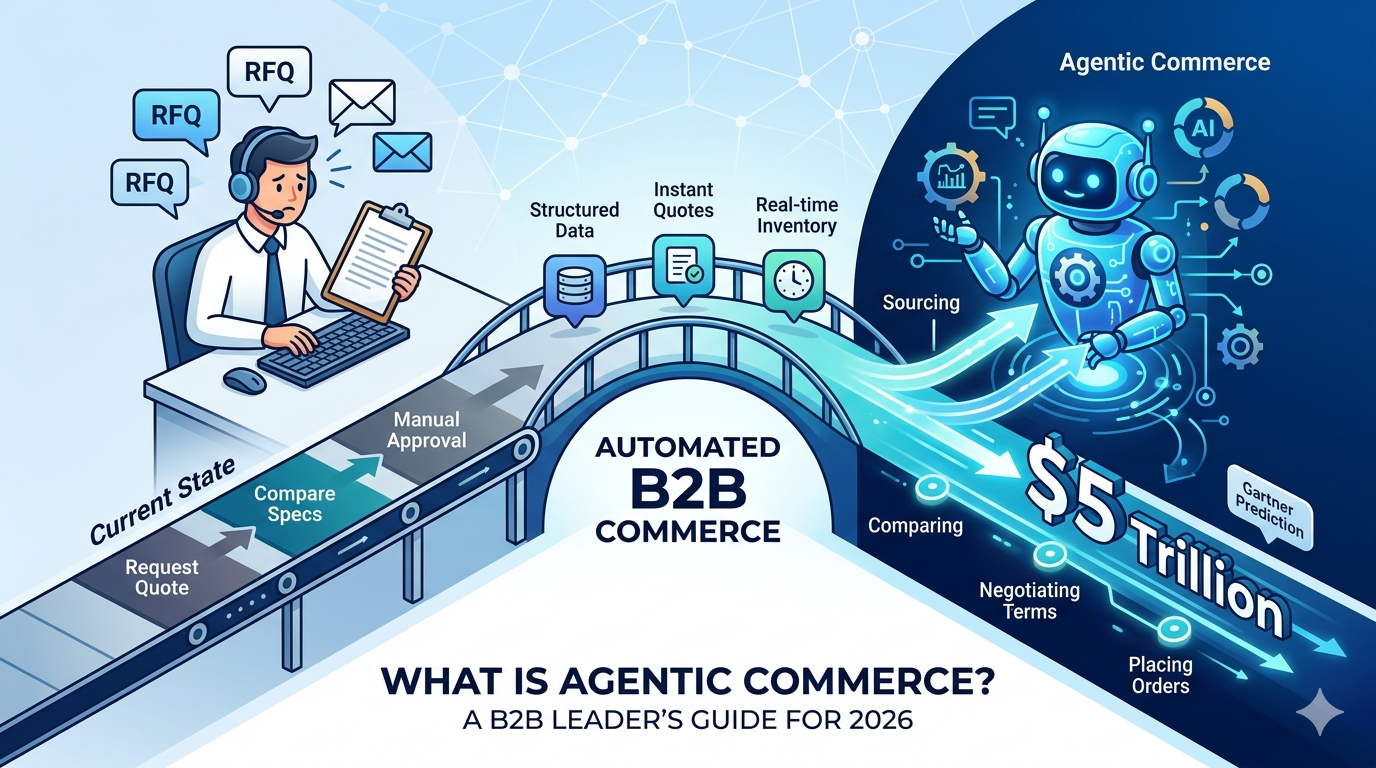
This guide explains what agentic commerce actually means, why B2B leaders need to care right now, and what practical steps you can take to prepare.
What Agentic Commerce Actually Means
Agentic commerce is the use of autonomous AI agents to carry out multi-step commercial tasks, researching products, comparing options, requesting quotes, negotiating terms, and completing purchases, all within defined guardrails set by a human.
Think of it this way: traditional eCommerce is a person browsing a website and clicking "buy." Agentic commerce is an AI agent doing the browsing, comparing, negotiating, and purchasing on behalf of that person or on behalf of an entire procurement department.
On the consumer side, this is already happening. ChatGPT's Instant Checkout launched in September 2025 and serves over 900 million weekly users. Google's AI Mode is directing purchase decisions through its Universal Commerce Protocol. PayPal launched agentic commerce services in October 2025 to make merchants discoverable to AI agents.
But here's what most coverage misses: the B2B opportunity is even larger.
Why B2B Agentic Commerce Is Different
Consumer agentic commerce is about convenience, helping someone find and buy the right pair of running shoes faster. B2B agentic commerce is about operational transformation, automating the complex, multi-step workflows that currently consume thousands of person-hours per year.
Consider a typical B2B purchase. A procurement manager at a manufacturing company needs to source 500 specialized fasteners. Today, they email three distributors an RFQ, wait 3–5 days for quotes, manually compare pricing and specs in a spreadsheet, negotiate terms, get internal approval, and then place the order. That single purchase might take two weeks.
💸 Margin compression. $390K in wasted labor. Relationship damage. RevPulse finds and fixes all three. See how RevPulse identifies revenue leaks in 30 days →
With agentic commerce, an AI procurement agent could search structured catalogs across multiple distributors, request and receive instant quotes, compare specs and pricing automatically, flag the best option for human approval, and complete the order, all in hours, not weeks.
The complexity that makes B2B commerce slow and manual is exactly what makes it ripe for AI agent automation: custom pricing per customer, complex approval workflows, technical specifications with hundreds of attributes, volume discounts and contract terms, and relationship-based selling with long cycles.
The Two Protocols You Need to Know
Two major protocols are emerging that will define how AI agents interact with commerce:
OpenAI's Agentic Commerce Protocol (ACP) was co-developed with Stripe and powers ChatGPT's shopping capabilities. It excels at conversational product discovery and is already processing real consumer transactions.
Google's Universal Commerce Protocol (UCP) was announced in January 2026 with backing from Walmart, Target, Shopify, and 20+ other partners. It captures high-intent search queries and will be integrated into Google Search AI Mode and Gemini.
For B2B companies, both protocols will eventually matter. But the more immediate impact is that enterprise procurement platforms are building their own AI agents that will need structured, machine-readable product data to work with your catalog.
What This Means for Your Business
If you sell B2B, agentic commerce affects three parts of your operation:
Your product data needs to be agent-ready. AI agents can only find, compare, and recommend products that have structured, complete, machine-readable data. If your catalog is a collection of PDFs and spreadsheets with inconsistent attributes, AI procurement agents will simply skip you in favor of competitors with cleaner data.
Your quoting needs to be instant. When an AI procurement agent can request quotes from five distributors simultaneously, the first accurate response wins. A 3–5 day quote turnaround becomes a competitive death sentence.
Your pricing and inventory need to be real-time. AI agents make decisions based on current data. Stale pricing or inaccurate inventory means lost orders and damaged trust with the procurement systems that increasingly control purchasing decisions.
How to Prepare: Three Steps
Step 1: Audit your product data. How many of your product attributes are complete and structured? Can a machine parse your catalog, or is critical information locked in PDFs and images? If more than 30% of your attributes are missing or inconsistent, this is your first priority.
Step 2: Measure your quote speed. How long does it take from RFQ receipt to quote delivery? If it's measured in days rather than minutes, you're vulnerable to competitors who automate this process.
Step 3: Evaluate your tech stack for agent readiness. Does your current system expose product data via APIs? Can your pricing rules be applied programmatically? Is your inventory data real-time? If the answer to any of these is no, it's time to invest.
The Window Is Now
The B2B companies that prepare for agentic commerce now will have a significant first-mover advantage. Those that wait will find themselves invisible to the AI agents that increasingly control purchasing decisions.
Gartner's $15 trillion prediction isn't about a distant future, it's about the next three years. Forrester says 20% of B2B sellers will face agent-led quote negotiations this year. The companies that can respond in minutes rather than days will win those deals.
The question isn't whether agentic commerce will transform B2B. It's whether your company will be ready when it does.
CommerceFlow is building the agentic commerce platform purpose-built for B2B. Our AI agents structure your product data, accelerate quoting, and optimize revenue, built for the complexity that generic AI can't handle. See how it works →